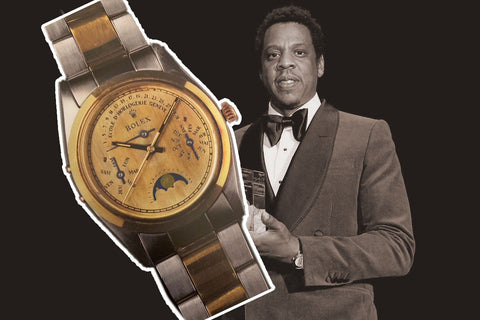

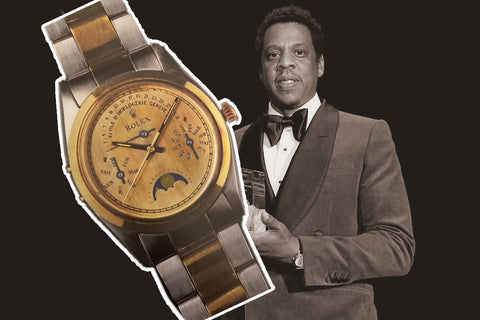

In the world of haute horlogerie, few stories have generated as much buzz as that of Jay-Z's supposed watch. It all started when a picture of the artist in the front row appeared, wearing what many immediately identified as a Rolex modified by Franck Muller. The reaction was instantaneous: the watchmaking community assumed it was a legendary piece.
But the reality is even more interesting.
Years earlier, fresh out of university, Franck Muller accomplished a technical feat that would mark the beginning of his career. He transformed a standard Rolex into a retrograde perpetual calendar, using only fifty handmade components, without altering the original case. An achievement that caught the attention of even Rolex engineers, who sought to understand how it had been possible.

That piece, considered one of the first expressions of his genius, briefly resurfaced in 2019 before disappearing into a private collection. Today, it's part of a museum in Tokyo, cementing its status as a cult object within Swiss watchmaking.

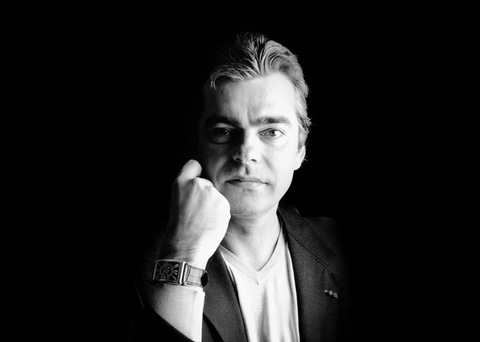
The watch associated with Jay-Z has a different origin. It's based on a Rolex Day-Date, later modified with a Dubois-Depraz perpetual calendar module, the same one used by brands like Audemars Piguet in the 1970s. This conversion was carried out by Antoine Preziuso, a close associate of Franck Muller, and its configuration matches the piece seen on the artist's wrist.

Franck Muller himself clarified this directly: that's not his original watch.
The truly unique piece remains that first creation. A handcrafted watch that not only defined the beginning of a career but also established a new standard in luxury watchmaking.

Because in haute horlogerie, true exclusivity needs no explanation. It's simply recognized.